10 Questions to Ask Before Choosing a Fabric Inspection Machine


A fabric inspection machine is the last point where the quality decision is made — and an investment you will use for years. Brochures talk about speed and camera counts; the right machine, however, is the one that answers the questions of your own line. In this article we go through the ten questions to ask before deciding, together with why each of them matters.
Choosing an inspection machine is not just a technical comparison. The system you choose determines the speed of your line, the daily work of your operators and the quality identity of every roll that goes to your customer. That is why the right questions should be asked of your own line first, not of the supplier. The ten questions below turn that evaluation into concrete criteria.
1. Which fabric types will it inspect?
The first question is not about the machine but about your production. Plain woven fabrics, knits (single jersey, interlock, rib), denim, automotive and technical textiles, coated fabrics — each carries a different defect signature and asks for a different feeding method. A system saying "all fabrics" is not enough; write down your own fabric mix and ask for a live demo on each of them.
An honest note: patterned and printed fabrics are the most demanding area of visual inspection, and that is true for manual inspection too — the standards keep inspection speeds even lower on patterned fabric. Ask your supplier openly about its approach to patterned fabric and its limits.
2. What is your line speed in metres per minute — and does the system run at that speed?
For reliable detection in manual inspection, most standards keep the speed below about 15 m/min; that is why on many lines quality control turns into the speed limit of production. The system you choose has to run at your line speed; otherwise part of the investment goes into slowing down.
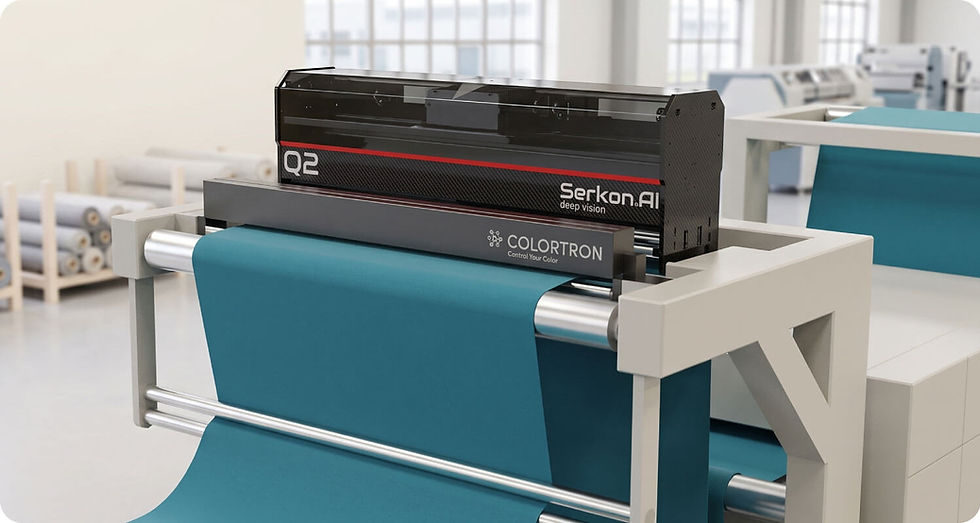
Serkon.AI Q2 scans the fabric continuously along the roll at 50+ m/min; the compact Q2 Lite is designed for speeds up to 30 m/min. The right question is not "what is the maximum speed?" but "does detection stay consistent at my speed?". The steps inspection goes through are described in detail here: What Are the Stages of the Fabric Quality Control Process?
3. How many defect types does it detect — and how does it prove it?
"AI-powered" on its own is not a criterion. The questions to ask: Which defect types are detected (holes, stains, skipped threads, thick picks, broken needles, streaks…)? Is detection real-time? How is the result shown?
Q2 detects more than 30 defect types in real time and records each of them with its roll, position and type. But the most reliable proof is not a number; it is a test: take your own fabric, with your own typical defects, to a live demo. It is your roll, not the brochure, that shows how accurate a system is.
It is your roll, not the brochure, that shows how accurate a system is.
4. Does it measure and score automatically?
Finding a defect is not enough; it has to be scored against a standard. In the widely used 4-Point System, defects receive 1–4 points according to their size and the total is calculated per unit area (usually 100 square yards); the acceptance threshold varies by buyer. For that calculation to be right, the fabric's width and length must be measured correctly too — a length error means even correctly detected defects are scored wrongly.
What to ask: Does the system verify width and length automatically? Is scoring manual or automatic? Can you define the acceptance threshold per customer? In Q2, defects are recorded with their roll, position and type; the 4-Point calculation is made automatically and the roll's grade is set against the threshold. Quality thus moves from a "looks fine" opinion to a number based on the same measure as your buyer's.
5. Does it work with your existing machine — or does it require replacing it?
This question sets the size of the investment. Many mills already have a conventional inspection machine that works well; what is missing is the scanning and recording layer. Being able to add the system onto the existing machine (retrofit) lowers both the cost and the installation time.
What to ask: Which winding types does it support — fold to roll, roll to roll, bigroll (batch) to roll? Does it change operating habits? Q2 can be added to the existing conventional machine with all three winding types; Q2 Lite is designed specifically to digitalize the existing manual machine. A short comparison of the two models:
Model | Speed | Typical installation | Who it is for |
Q2 | 50+ m/min | New line, or added to the existing inspection machine | High-speed lines; woven, knit, denim, automotive and technical textiles |
Q2 Lite | Up to 30 m/min | Digitalizes the existing manual inspection machine | Mills that want to go digital while keeping their existing machine |
6. How does it record and report defects?
Seeing a defect is not enough; it has to be turned into evidence. Does the system record every defect with its roll, position and type? Does it produce a defect map across the fabric width? Can that data be exported as a report and XML, and integrated with your ERP or other software?
This is the question that ends the "was that defect really there?" discussion when a buyer objection arrives. Without a record, quality remains something that is remembered.
7. Does it mark defects physically?
A digital record alone is not enough: after the fabric is cut or rewound, you need to find physically where the defect is. Is there an edge-labelling system, does it stop the line, does it work according to the flow speed?
The NON-STOP LABEL principle in Q2 marks defects physically along the fabric edge; even if the fabric length changes, the defect position is not lost, and this happens without stopping the line. It is a criterion that saves time on the cutting and garment side and is often overlooked.
8. Can color be controlled on the same line?
Surface defects are not the only dimension of quality; shade differences between rolls, shade variation across the width and color drift within a roll also lead to returns. In most mills color is still checked by cutting a swatch and sampling under a light cabinet. Can the system measure color inline?
On the Serkon.AI line, Q2 does the defect detection; Colortron measures color on the same line: under D65 standard light, with repeatable precision down to ΔE 0.05, including shade variation across the width (left, center, right), continuously along the roll. Both layers are managed from a single control screen. If color is critical for you, ask this question on day one — adding it later is possible, but planning it is cheaper. Details: Fabric Quality Is a Whole — Defect and Color Control Together
9. What happens to the operator's role — and how do installation and adoption go?
A good system does not remove the operator; it changes the role. The operator is no longer the person scanning every roll by eye, but the person who reviews the detections the system has marked and approves the final quality decision. What to ask: Can the interface be learned on the shop floor? How long does the line stop during installation? Do operating habits change?
Be sure to ask this question together with the operator at the head of the line — that is the person who will use the system every day.
10. What is the total cost — and how does it pay for itself?
The price list is only the first line of the investment. The real calculation is made on three items: labor (the operator manages the line instead of scanning the fabric by eye — often with up to 50% less inspection labor than manual methods required), the cost of missed defects (rework, disputed rolls, returns) and speed (a line that does not slow down because of inspection). When you write these three items down with your own numbers, the payback period becomes clear too. Details: Reducing Quality Control Labor Cost — The Impact of Artificial Intelligence

Decision Summary
The common denominator of the ten questions is this: the right machine is the one that works on your fabric, at your speed, on your existing line and turns every defect into evidence. That is why the final advice is a single sentence: before you decide, ask for a live demo with your own fabric.
Q2 or Q2 Lite — let's evaluate together which one fits your line.
Sıkça Sorulan Sorular
What is the difference between Q2 and Q2 Lite?
Q2 is the main system, running at 50+ m/min for woven, knit, denim, automotive and technical textile lines. Q2 Lite is the compact solution that digitalizes the existing manual inspection machine, designed for speeds up to 30 m/min.
Do I need to replace my existing inspection machine?
No. The system is added to your existing conventional machine — fold to roll, roll to roll or bigroll (batch) to roll — and does not change operating habits.
Is there a figure for detection accuracy?
The most accurate answer is your own fabric: accuracy depends on the fabric type, the defect type and the line conditions. That is why we recommend a live demo with your own fabric and your typical defects before you decide.
Can I add color control later?
Yes. Colortron can be added later to the existing conventional inspection machine or at the stenter exit; planning it from the start, however, is more efficient for installation.
How long does the line stop during installation?
It depends on the winding type and the existing machine; in the pre-assessment, an installation plan specific to your line is prepared.