
Fabric Defects Guide: The 30 Most Common Defects, Their Causes and Detection


Most fabric defects are born on the machine; the cost is paid at the cutting table or in the customer's warehouse. This guide brings together the 30 defects most often seen in woven and knitted production, in six groups. For each one we explain what it looks like, which stage it comes from and why it can slip through on the inspection line. Names follow common industry usage (in line with ASTM D3990 terminology where it applies); different mills may use different names for the same defect.
At the end you will find two short sections — how defects are recorded (which roll, which position, which type) and how they are scored in the 4-Point system — followed by a short FAQ.
1. Warp and weft defects in woven fabric
In woven fabric, most defects come from one of the two yarn systems breaking, skipping or being fed incorrectly. The rule of thumb is simple: defects that run along the length of the fabric usually come from the warp; defects that run across the width usually come from the weft (filling).
1. Broken end
A broken warp yarn leaves a thin, straight line or gap running along the length of the fabric. Typical causes are low yarn strength, a wrong tension setting or a poorly tied knot. Because it can run for a long distance in the warp direction, detecting it early saves most of the roll; in visual inspection, being thin and straight, it can blend into the background as line speed increases.
2. Broken pick / missing pick
A weft yarn that breaks or is not inserted at all leaves a thin, open line across the width. It usually comes from the weft feeding or weft insertion system. On its own it looks minor; but if it repeats in the same roll, it is a sign of a systematic problem on the loom.
3. Thick pick
A weft yarn thicker than normal creates a visible, raised line across the width. Typical causes are mixed yarn lots or double-yarn feeding. It becomes even more visible after dyeing, because the thicker area takes up dye differently. It is one of the woven-fabric defects most frequently recorded on the inspection line.
4. Float
One or more weft yarns skip over the warp without interlacing, leaving a loose, shiny length of yarn on the surface. It comes from a weave error or from a broken end that was noticed too late. Because it can be pulled during cutting and sewing and open a hole, it is scored heavily.
5. Double pick
Two picks inserted in the same shed leave a dense, thick line across the width. It comes from the pick counter or from the restart setting after a loom stop. It looks similar to a thick pick; when the two are recorded as separate types, the report makes machine-level root-cause analysis possible.

2. Loom and setting defects
The defects in this group come not from the yarn but from the loom settings or from stops and restarts. Most of them do not run along the entire fabric but repeat at certain intervals — which is why the position record is the key to finding the root cause.
6. Stop mark
When the loom stops and restarts, the pick density is disturbed and a thin or dense band forms across the width. Since it can form at every stop, its frequency also tells you how often the loom stops. It shows clearly under light on light-colored plain grounds; on patterned fabric it can be easy to miss.
7. Reed mark
Worn reed dents or the wrong reed count leave fine, evenly spaced lines along the fabric. It runs in the warp direction for the whole roll. Because it is parallel and regular, the eye may read it as "part of the design" and pass over it.
8. Warp streak
Warp yarns from a different lot or with a different twist mixed into the warp create a band of shade or luster difference along the fabric. It originates in warp preparation and becomes visible after dyeing. It is a typical defect where surface inspection and color control overlap.
9. Pattern defect (dobby / jacquard)
A fault in the dobby or jacquard system causes part of the weave repeat to interlace wrongly; warp yarns stay loose on the surface or the pattern shifts. On patterned fabric it is one of the hardest defects to see by eye, because the defect hides inside the pattern.
10. Selvedge defect (bad selvedge)
The fabric edge is broken, curled, too tight or too loose. It comes from selvedge yarn tension, the selvedge weave or the take-up system. Because it falls within the cutting allowance, it is often not scored; but it causes gripping problems on the stenter pins and distorts width measurement.
3. Knitting defects
In knitted fabric, defects mostly come from the needles, yarn feeding and machine cleanliness. In structures such as single jersey, interlock and rib, the same defect may look different; what they have in common is that most of them run as a vertical line along the fabric.
11. Drop stitch / ladder
When a loop is not held, the loops unravel one after another and form a vertical ladder. Causes are yarn breakage, needle damage or yarn tension. It grows when the fabric is stretched; if the tension on the inspection line is set wrongly, it either looks exaggerated or closes up and can be missed.
12. Needle line
Loops formed by a damaged or differently set needle appear as a thin vertical line along the fabric. Because the source is a single needle, the defect repeats at the same position along the whole roll. The position in the record tells you directly which needle needs to be changed.
13. Needle hole (broken needle)
Where a needle is broken, no loop is formed, and a line of small holes appears along the fabric. It is one of the most frequently recorded defects in circular knitting. Because it is small and regular, it can be easy to miss in visual inspection, especially on a dark ground.
14. Tuck defect
When the old loop fails to clear the needle, or the yarn is held as a tuck instead of forming a new loop, small knot-like bumps or local thickening appear on the surface. Cam settings and damaged needle latches are the main causes.
15. Barré
Different yarn lots, different twist or differences in feed tension leave periodic bands of shade and texture across the width. It appears in both knitting and weaving and becomes visible after dyeing. It is noticed not by cutting a swatch and checking it in a light booth, but by looking continuously along the roll — which is why it tends to surface earlier in mills where surface inspection and color control run on the same line.
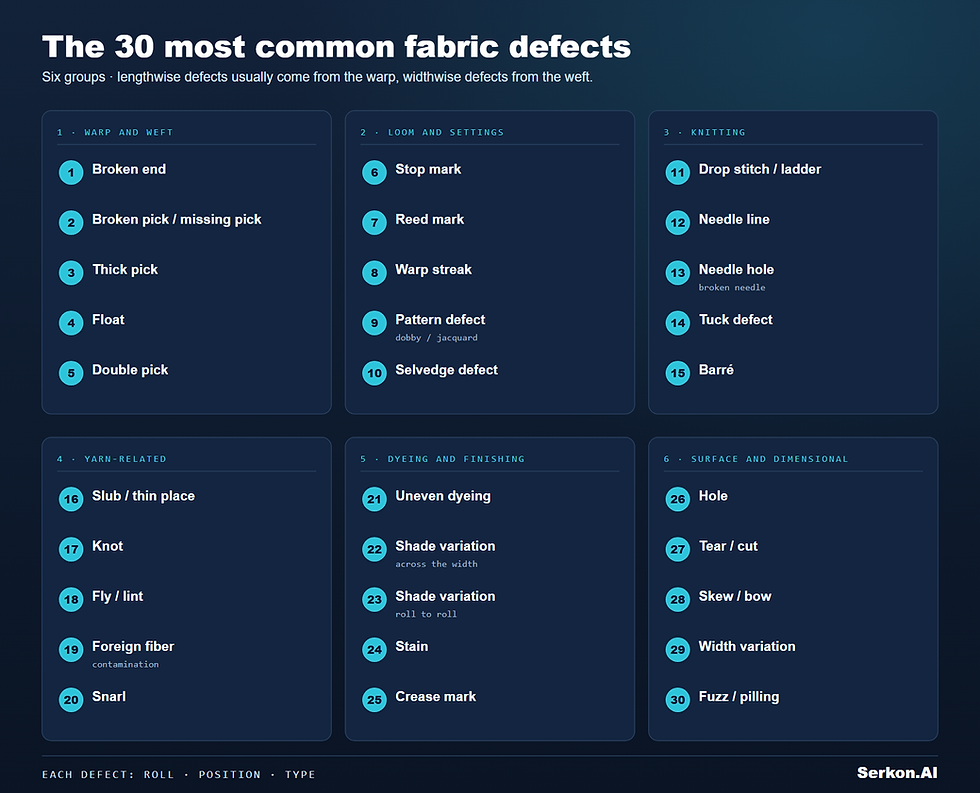
4. Yarn defects
These defects come from the yarn, not from the loom or the knitting machine — so they repeat on every machine that runs the same yarn lot. The "type" field in the record tells you whether the problem belongs to the yarn supplier or to the machine.
16. Slub / thin place
A section of yarn that is thicker or thinner than normal leaves a short, irregular bump or dip in the fabric. It originates in spinning. It should not be confused with intentional effects such as fancy slub yarns; when the fabric style is defined in the system, a thick place is correctly assessed as either design or defect.
17. Knot
Knots left from tying broken yarns appear as dots on the fabric surface. In garment making they can break sewing needles and leave visible marks on the surface. Because they are small, their number is often estimated — yet correct scoring requires counting them.
18. Fly / lint
Airborne fiber fly trapped in the yarn or fabric leaves fine tufts of fiber in a different color on the surface. Light-colored fly is especially visible on dark fabric. The source is not the machine but the cleanliness of the environment; its frequency says something about the ventilation and cleaning routine of the knitting or weaving hall.
19. Foreign fiber / contamination
Foreign matter such as polypropylene, hair or cotton of a different color mixed into the yarn. Because it does not take up dye, it often only shows after finishing. It is among the defects most likely to pass greige inspection unnoticed, and among the most expensive ones at finished-fabric inspection.
20. Snarl
Over-twisted weft yarn curls back on itself and forms a small loop or bead. It comes from yarn twist and the weft braking setting. It shows as raised, shiny dots on the surface; it should not be recorded under the same type as a thick pick, because the root causes are different.
5. Dyeing and finishing defects
These defects are not present in the greige fabric; they are born in the dyehouse and on the finishing line. Unlike surface defects, most of them fall under "color" and look different depending on the light — which is why standard light (D65) and measurable color difference (ΔE) are used as the reference.
21. Uneven dyeing
Dye that is not distributed evenly across the fabric gives cloudy, wavy or banded shade irregularity. Causes are insufficient pretreatment, temperature and liquor circulation. In visual inspection it is the most disputed defect, because perception varies from person to person and with the light; measurable color difference ends the debate.
22. Shade variation across the width
A shade difference between the left, center and right of the fabric (also called side-to-center shading or listing). It comes from temperature or pressure differences across the width in stenters and dyeing machines. It shows up in garment making when two panels of the same product are cut from different edges — which is why measurement at three points across the width (left, center, right) is needed.
23. Shade variation, roll to roll
A color shift between rolls of the same batch, or from start to end within a single roll. It comes from the dye recipe, mixed batches or drying conditions. An inspector looking at one roll at a time may not see it; when rolls are lotted against their ΔE reference, the difference becomes visible.
24. Stain
Oil, rust, dirt or dye stains come from machine lubrication, handling and storage. Depending on its size, a stain takes heavy points in the 4-Point system. The position record is critical for finding the source: an oil stain that keeps repeating on the same edge points to a specific roller on the line.
25. Crease mark
When fabric passes through finishing machines folded or pinched, a permanent line or shiny mark forms. It occurs in wet processing and on the compactor (sanforizing). It may look small on its own, but it can run along the whole roll and cause panel loss at cutting.
6. Surface and dimensional defects
The last group is about the physical integrity and the dimensions of the fabric. Some of these defects are easy to see by eye; the real challenge is recording them correctly and measuring them consistently.
26. Hole
An opening formed when one or more yarns break; it can come from needle damage in knitting, mechanical strain in weaving or chemical damage in finishing. It is the most heavily scored defect: under most buyers' 4-Point rules it takes 4 points regardless of size.
27. Tear / cut
A mechanical tear or cut in the fabric, caused by handling, blades or tensioning. It usually starts at the edge. If its position is recorded, that zone is skipped in the cutting plan; if not, it comes back as panel-level waste.
28. Skew / bow
Weft yarns that are not perpendicular to the warp but angled (skew) or curved (bow). It comes from stenter and drying tensions. It causes pattern misalignment in cutting and sewing; it has to be measured across the width, because estimating it by eye is not reliable.
29. Width variation
Fabric width that differs from the order specification, or varies within the roll. It comes from stenter settings and shrinkage. It is not a surface defect as such, but it affects the cutting plan and the area used for scoring. This is why width and length should be verified automatically on the inspection line.
30. Fuzz / pilling
Fibers lifting from the surface or forming small balls; it comes from yarn structure, finishing and abrasion. It increases with short-staple yarns and with brushing and sueding processes. It rarely figures in scoring, but it is one of the frequent reasons for buyer claims.
Seeing the defect is not enough: which roll, which position, which type
All 30 defects have one thing in common: they do not report themselves. In manual inspection a defect may be noticed, but it is often not recorded systematically; when a buyer claim arrives, the question "was that defect really there?" is left to memory. A record needs three pieces of information: roll, position and type. We describe the full process here: Fabric Quality Control Process: What Are the Stages?
Serkon.AI Q2 scans the fabric continuously along the roll, detects 30+ defect types in real time and records each detected defect with its roll, position and type; when the roll is finished, the defect map and report are ready, exported / integrated to your ERP. Color defects (uneven dyeing, shade variation across the width, roll-to-roll shade variation) are measured on the same line with Colortron: under standard D65 light, with repeatable precision up to ΔE 0.05, continuously along the roll. Q2 defect detection + Colortron color control. The record does not depend on the person: the same defect is marked the same way regardless of operator or working hours. More detail: Fabric Quality Is a Whole: Defect and Color Control and AI Fabric Inspection: The 16 Most Asked Questions.
Defects do not report themselves; without a record, a defect remains something people only remember.
From defect to points: what happens in the 4-Point system?
Each recorded defect gets 1–4 points depending on its size; the total is normalized to a set area (usually 100 yd²), and the roll passes or fails against the buyer's threshold. The threshold is typically around 20 points per 100 yd², though it varies by buyer. In most buyer standards, defects such as holes take the highest score regardless of size. For scoring to be correct, width and length must be measured as accurately as defects are counted; we cover this in question 4 of our machine selection article: 10 Questions to Ask When Choosing a Fabric Inspection Machine.
Which defect repeats most on your line?
Not all thirty defects in this guide appear equally often in every mill; every fabric type and every line has its own defect signature. Learning that signature from records rather than estimates changes both root-cause analysis and the conversation with your buyer.
Let's look together at how the defects in your own fabric are detected.
Short FAQ
What are the most common fabric defects?
In weaving: thick picks, broken picks and broken ends, and stop marks; in knitting: drop stitches, needle lines and broken-needle holes; in finishing: uneven dyeing, shade variation across the width and stains; and in every fabric type, holes and foreign fiber are among the most frequently recorded defects. The ranking varies by fabric type and line.
How are fabric defects scored?
The most common method is the 4-Point system: each defect gets 1–4 points depending on its size, the total is normalized to an area unit such as 100 yd², and the roll passes or fails against the buyer's threshold — typically around 20 points per 100 yd², though it varies by buyer. In most buyer standards a hole takes the highest score regardless of size.
Do color defects count as surface defects?
The industry treats them separately: uneven dyeing, shade variation across the width and roll-to-roll shade variation are color defects. Because they look different under different light, they are assessed under standard D65 light with measurable color difference (ΔE). On a Serkon.AI line, Q2 detects the surface defects and Colortron measures color — Q2 defect detection + Colortron color control.
Why is recording defects so important?
Without a record, a defect remains something people only remember: there is no evidence when a buyer claim arrives, the root cause cannot be found, and the same defect is argued over again and again. A record kept with roll, position and type makes both the roll report and machine-level analysis possible.
Which of these defects does Serkon.AI Q2 detect?
Q2 detects 30+ defect types in real time and records each detection with its roll, position and type. The most reliable way to see how the defects in your fabric are detected is a live demo with your own fabric and your typical defects.


