
Reducing Quality Control Labor Cost: The Impact of Artificial Intelligence


Quality control labor cost is one of the most continuous, yet often overlooked, expenses in fabric manufacturing. When discussing fabric quality control, speed and accuracy usually take the spotlight. However, from a production manager’s perspective, labor remains a fixed cost item that increases as production volume grows.
Manual inspection relies on operators who work in shifts, require continuous training, get tired over time, and may interpret the same fabric differently. As production speeds increase, this cost does not only grow; it also becomes less predictable.
In this article, we focus on one key question: Is it possible to manage the same fabric inspection capacity with fewer operators and greater consistency?
The Real (and Hidden) Quality Control Labor Cost
The cost of manual quality control is not limited to the wages paid to operators. There are three interconnected cost layers:
Direct labor cost: Operators per shift × shifts × year. This is a recurring cost that increases with production capacity.
Cost of human error: Missed defects caused by fatigue and subjective judgment may lead to second-grade fabric, waste, and rework.
Indirect cost: When an undetected defect reaches the customer, it may result in complaints, returns, and loss of brand trust.
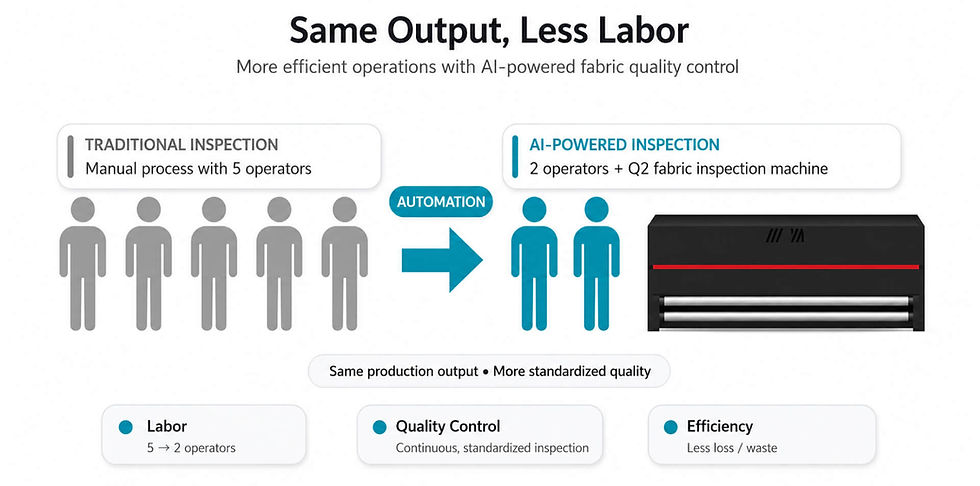
How Many Operators Are Needed for the Same Capacity?
In manual inspection, increasing capacity usually means adding more people. AI-assisted fabric inspection changes this equation: inspection capacity shifts from human dependency to the machine and algorithm, reducing the need for operators.
A representative comparison:
Manual Inspection | Serkon AI - Q2 | |
Operators / Shift | 5 | 2 |
Operation | Dependent on operator and shift conditions | Standardized and traceable |
Risk / Role | Fatigue → missed defects | The operator manages, the system scans |
Labor Requirement | Baseline | Approximately 60% lower |
~60% less labor · 30+ defect types · 24/7 consistent, fatigue-free inspection
Artificial Intelligence Does Not Replace the Operator — It Elevates the Role
AI-assisted inspection does not mean “operator-free production.” The operator does not disappear; the role becomes more strategic.
Instead of continuously watching fabric for hours, the operator now evaluates the defects flagged by the system, confirms decisions, and manages the inspection process.

Quality control is no longer an operator-dependent interpretation; it becomes traceable and reportable data.
The Gain Beyond Labor: Standardization and Traceability
Serkon.AI Q2 records every detected defect with its location, defect type, and roll/batch information.
This means that the same fabric is evaluated consistently across different shifts. Discussions such as “Was that defect actually there?” are replaced by evidence-based records. At the same time, the quality department gains actionable data for process improvement.

An Example: The Annual Impact of Labor Savings
A representative calculation — figures may vary depending on your own operation — can be made as follows:
If 3 operators per shift are saved, moving from 5 operators to 2, and the annual total cost of one operator to the company is M, then the annual direct labor saving is approximately: 3 × M
When reductions in waste, rework, and customer complaints are also included, the return on investment period becomes significantly shorter.
Same capacity, approximately 60% less labor: an inspection process managed by 5 operators in manual control can be handled by 2 operators with Serkon.AI Q2.
Conclusion
In quality control, labor may appear to be a fixed cost that cannot be reduced — until inspection capacity shifts from people to machines.
The real question is:
How many operators on your line are still chasing defects that should be detected visually?

Frequently Asked Questions
Does AI completely eliminate quality control operators?
No. It reduces the number of operators required and elevates their role from “searching for defects” to “managing the system and approving decisions.”
Does it work with my existing machine?
Serkon.AI Q2 can operate as a retrofit or standalone solution. Q2 Lite is primarily designed for retrofit applications.
How much labor saving can be achieved?
It depends on the production line, capacity, and current number of operators. The exact saving can be calculated through a free preliminary assessment.


